The short answer: a hydraulic press forms, bends, punches, or straightens metal by applying force to shape it, while a hydraulic shear machine cuts metal cleanly through it. One changes the shape of the material without separating it; the other separates it. They're often used in sequence, not as substitutes for each other.
What a hydraulic press does
A hydraulic press applies controlled force through C-frame, H-frame, or four-post configurations, with capacities up to 200 ton and stroke lengths up to 1500 mm. It's used for bending, punching, forming, straightening, and assembly operations across automotive, aerospace, and general fabrication work, with manual or PLC touchscreen control depending on the model.
What a hydraulic shear machine does
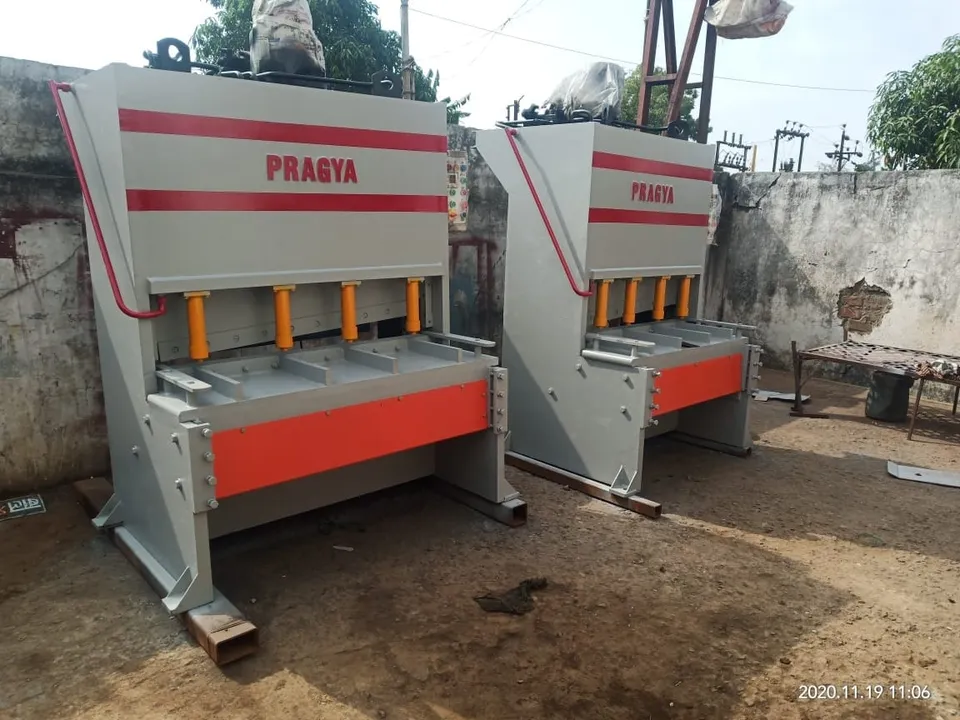
A hydraulic shear machine cuts steel plates and sheets to size with clean, burr-free edges, handling mild steel up to 25 mm and stainless steel up to 20 mm, with cutting lengths from 3000–4000 mm. Standard and heavy-duty variants are available, sized to material thickness — our guide to hydraulic shear machine types and applications covers the range.
Side-by-side
| Hydraulic Press | Hydraulic Shear Machine | |
|---|---|---|
| Function | Forms/shapes metal (bending, punching, straightening) | Cuts metal to size |
| Capacity | Up to 200 ton | Mild steel to 25 mm, stainless to 20 mm |
| Length/stroke | Stroke up to 1500 mm | Cutting length 3000–4000 mm |
| Control | Manual, PLC touchscreen | Standard or heavy-duty back gauge |
| Typical use | Bending, punching, forming, straightening, assembly | Sizing plate/sheet before or after forming |
When you need which
If your process needs to change a part's shape — bend a bracket, punch a hole, straighten a bar — you need a press, sized by tonnage to the material and operation. If your process needs to reduce a larger plate or sheet to the size you'll actually work with, or trim a formed part to final dimension, you need a shear. Most fabrication shops run both: shear the plate to size first, then press it into shape, or shear off excess after forming. Neither substitutes for the other — check whether your bottleneck is cutting stock to size or shaping it before deciding which machine to add capacity to.
Where the two overlap in a workflow
A typical steel fabrication sequence brings raw plate in oversized, shears it down to blank size on the shear machine, then moves the blank to the press for bending, punching, or forming. Running the shear first keeps the press working on material that's already close to final dimension, which reduces wasted press strokes on material that will be trimmed later anyway. For shops with only one of the two machines, the missing step usually gets outsourced or done with a less efficient substitute — a manual saw instead of a shear, or a smaller press run multiple times instead of one properly sized stroke.
Specification differences that matter
Press specification centers on tonnage, stroke length, and frame type matched to the heaviest and deepest forming job. Shear specification centers on material thickness capacity and cutting length matched to the largest plate or sheet the line handles. Because the two machines solve different problems, sizing one generously doesn't reduce the need to size the other correctly — a well-specified 200 ton press does nothing to widen a shear's 25 mm mild steel cutting limit.
Export Availability
Manufactured at Pragya's Pithampur (Indore) works and exported to steel mills worldwide — 22+ countries across 5 continents to date. Every export order ships with mill test certificates, ocean-freight packing, and full customs documentation, quoted FOB or CIF.
Interested in our industrial equipment?
Our export team, based in Indore, India, will recommend the right solution and quote FOB or CIF pricing for your shipment.
Request a quote